

Life with HIE starts before the NICU, and continues long after. Our understanding should, too. Some of the biggest questions about HIE need answering, data gaps need filling, and this is the way we collectively get to do that critically important work.
The registry will open to our global community in 2027.
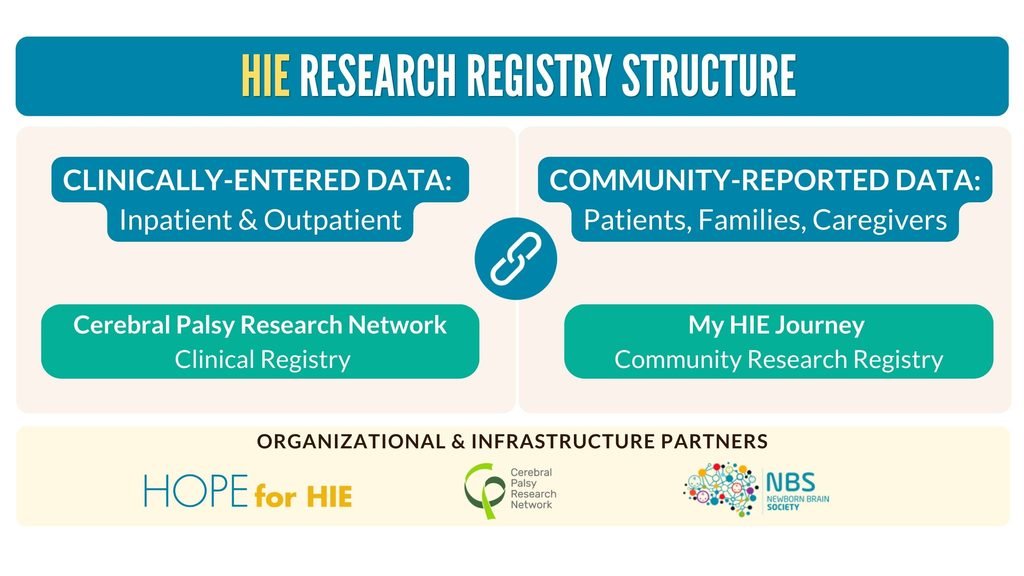
Hope for HIE is working with the Cerebral Palsy Research Network and Newborn Brain Society to build a global community research registry that connects medical information with the experiences of ALL children with HIE and families over time, leveraging the individual and collective strengths and resources of these three organizations to build something important and meaningful.
The research registry is for everyone in the HIE community -- those with or without cerebral palsy, across any outcome including loss, and patients born or diagnosed with neonatal or pediatric-acquired HIE, in addition to their families and caregivers.
Together, we’re building evidence to better understand HIE, improve care, and guide research toward what matters most to our community.
The HIE Registry brings together information from participating hospitals and experiences shared directly by families to better understand HIE, improve care, and guide research. Patient-Families in the HIE community have helped shape this work from the beginning. Community priorities help identify the questions research needs to ask.
Medical information about HIE, NICU care, and developmental outcomes, collected by participating hospitals. All data is deidentified to protect privacy. Use of common data elements to harmonize global collected data from other registries.
Patient-family surveys about development, care, every day life, and the experiences that medical records alone cannot capture. Taking lived experience, anecdotes and trends from years of sharing in our peer community to build research questions, and explore new possibilities.
The HIE Registry is being built to include children who have experienced HIE, whether or not they have a cerebral palsy (CP) diagnosis. Understanding the full range of outcomes—including why some children develop CP and others do not—is an important part of learning how to better support children and families after HIE.
EXPLORE FEASIBILITY
The Work Begins: Hope for HIE, CP Research Network, and research partners began exploring the feasibility of an HIE registry that would connect clinical information with family experience and address gaps in long-term data.
BUILD THE TEAM & FUNDS
Build the Team: Dr. Danielle Barber agreed to serve as the Principal Investigator, and other team members from the Newborn Brain Society, CP Research Network and Hope for HIE came together to apply for a proof of concept grant, and won the grant funding!
LAUNCH THE PILOT
Proof of Concept: Initial grant funding supported building and testing the registry model at two hospitals, with clinical data collection and caregiver surveys.
EXPAND THE FOUNDATION
Funded Expansion: A three-year PERF grant supports six clinical sites, consistent developmental information through PediaTrac, and more family-reported outcomes, building out the community registry to the entire HIE community at large.
OPEN TO THE COMMUNITY
Launch at Scale: Planned integration and launch through the upcoming My HIE Journey community platform, to connect research, support and education in one place for HIE patient-families.

LEARN TOGETHER OVER TIME
Across the Lifespan: Fill data gaps, understand HIE across the lifespan, and support research that reflects meaningful outcomes for patient-families.
See what we're building, what we've learned, and how patient-family and community experience is shaping the questions we ask.

Principal Investigator - Danielle Guez Barber, MD, PhD
Danielle is a neonatal neurologist and basic scientist studying HIE and neonatal brain injury at the University of Colorado, an HIE parent, and serves on Hope for HIE's Board of Directors and Medical Advisory Board.
Blending science and lived experience, she drives forward the registry, setting the strategic foundation and vision with the team.

Co-Principal Investigator - Joyce Trost, PT, PhD
Joyce is a physical therapist, researcher, and Vice President of Research and Quality Improvement at the Cerebral Palsy Research Network, with decades of experience advancing pediatric research.
Blending clinical expertise and a commitment to family partnership, she helps guide the registry’s research infrastructure and development with the team.
The core registry team has been meeting weekly since 2024, and has transitioned to the Steering Committee of the expansion work. We are fortunate to have committed, talented, and heart-driven partners. The steering committee has representation from community and patient-family members, clinical sites, and organizational partners.

Pictured L to R: Dr. Eric Peeples (Newborn Brain Society & University of Nebraska), Betsy Pilon (Hope for HIE), Maggie Jalowsky (Hope for HIE), Dr. Danielle Guez Barber (Principal Investigator, University of Colorado & Hope for HIE), Dr. Zach Vesoulis (Site Investigator, Washington University at St. Louis), Paul Gross (CP Resarch Network), Joyce Trost, PhD (Co-Principal Investigator, CP Research Network). Not pictured: Patrick McPhee, PhD (CP Research Network).







As part of the expansion, the registry is phasing in PediaTrac™, an online tool that tracks how babies grow and develop. It was created by Dr. Renée Lajiness-O'Neill and Dr. Seth Warschausky.
Parents and caregivers answer short online surveys about their child at ages that match routine well-child visits: newborn, then 2, 4, 6, 9, 12, 15 and 18 months. The surveys cover movement, communication and thinking, sleep, feeding, and the bond between baby and caregiver. Families can do them from home on a phone, tablet or computer, with no extra trip to a clinic.




Funding for the expansion grant was awarded by the Pediatric Epilepsy Research Foundation (PERF) to whom we are grateful for their investment in the future of the HIE community, the institutional resources of Hope for HIE, CP Research Network and the Newborn Brain Society, and general giving to Hope for HIE and CP Research Network that make this possible.
Want to support the continued work of the HIE Registry?
A research registry is a database that collects medical and daily living information from individuals with a specific condition, in this case, hypoxic ischemic encephalopathy (HIE). It helps researchers track health trends, treatment outcomes, and the needs of people affected by HIE.
There are several types of research registries, each serving different purposes. Some registries are designed to track the long-term outcomes of a specific condition, like HIE, while others focus on treatment effectiveness or quality of life data. Registries can also be population-based, collecting data from a broad group of people, or specific to a particular condition, treatment, or region. The HIE registry is a condition-specific registry, aimed at gathering valuable insights into the experiences, needs, and outcomes of those impacted by HIE.
This research registry aims to improve understanding of HIE, fill data gaps, and ultimately lead to better support, care, and treatments. By gathering data from HIE families, researchers and healthcare providers can identify patterns, address gaps in care, and tailor interventions to help those impacted by HIE.
Currently, while Hope for HIE's deidentified anecdotal data share across its social media support groups has been instrumental in accelerating research, it is not a registry and is not intended to be one.
CPRN brings experience building research registries, clinical infrastructure, and connecting families, clinicians, and researchers. They are undertaking work for earlier detection of CP. HIE is an at-risk population, and we share an interest in understanding children’s development, identifying support needs earlier, and improving care over time.
Together, we’re building a registry that connects medical information with families’ lived experiences to better understand life after HIE—from movement and learning to behavior, sleep, participation, and family well-being.
The planned registry will have TWO parts:
Electronic Medical Record (EMR) Enrollment: Building off of the existing Cerebral Palsy Research Network database, and collaborating with the Newborn Brain Society who has been undertaking work to identify Common Data Elements to be used across any HIE data registry. Families will be able to opt-in at the point of diagnosis in the NICU to automatically have their children's deidentified data included in the registry from their medical records.
Patient-Family Inputted Data: Utilizing a similar format to the CPRN MyCP patient-family registry, the HIE patient-family research registry will be built in two phases. The first phase focuses on neonatal HIE, and the second phase will be for pediatric-acquired HIE. Patients and families will be asked to share data about the patient or child that will be deidentified in the data collection center about the medical, educational and life experiences with HIE.
Families can and DO make a difference in research! Participating means adding your story and data to a larger picture, which will help advance research, improve resources, and potentially influence treatment and policy. Every piece of information helps us understand HIE more deeply and drive change.
Currently, while Hope for HIE's deidentified anecdotal data shared across its social media support groups has been instrumental in accelerating research, it is not a registry and is not intended to be one.
YES! While we are partnering with the Cerebral Palsy Research Network, because there is an overlap of interest in babies who are at-risk for CP, and the HIE community, this project is inclusive of the ENTIRE HIE community, and across all outcomes, including loss.
The HIE research registry is built on the successful and long-standing Cerebral Palsy Research Network's platform, not a random untested or personal platform, to ensure it meets rigorous standards protecting privacy and data.
Key Privacy & Data Protection Practices
Hear from the families, researchers, and partners building the HIE Registry—and learn how our community’s experiences are shaping what comes next.
HIE Registry Progress: CPRN Webinar
April 9, 2026
Creating an HIE Registry
November 19, 2024
The Importance of Data and Community Engagement in HIE Progress
April 2024
Get registry news and learn when broader enrollment opens.
Signing up for updates does not enroll you in the registry.
Connect with families, read inspiring stories, and get helpful resources delivered right to your inbox.


Connect with families, read inspiring stories, and get helpful resources delivered right to your inbox.
