

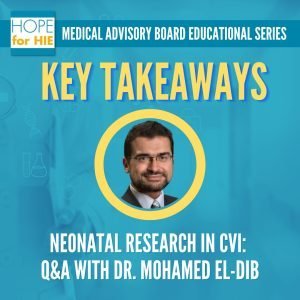
At Hope for HIE, we work to connect the HIE community with the researchers and clinicians shaping the future of HIE care. In the latest session of our Medical Advisory Board Educational Series, board member and HIE parent Melissa Akinlawon, MA, sat down with Dr. Mohamed El-Dib, MD, Director of Neonatal Neurocritical Care at Mass General Brigham for Children, to talk about cortical visual impairment (CVI) and its connection to HIE.
Dr. El-Dib walked us through what CVI is, why it matters for babies with HIE, what his team's research is learning about identifying at-risk babies earlier, and what families can watch for and do right now.

Melissa Akinlawon, MA, serves on Hope for HIE's Board of Directors and works in health communication at a public health nonprofit. In her first time hosting the series, she brought both her professional expertise and her experience as the parent of a six-year-old born with HIE.

Dr. Mohamed El-Dib, MD, is Director of Neonatal Neurocritical Care at Mass General Brigham for Children, as well as an associate chief for academic affairs and an associate professor at Harvard Medical School. He also serves on the Hope for HIE Medical Advisory Board.
Much of Dr. El-Dib's research has focused on HIE itself: how to monitor babies after a brain injury and how to better protect the brain. Vision, he explained, kept showing up as an outcome in major HIE studies, including the cooling (therapeutic hypothermia) trials. But few people talked about CVI as its own condition. His involvement in the research study described below is what introduced him to CVI and how much it can shape a child's development.
Missed the stream? No worries. Like any good partner, we took notes and are willing to share!

Cerebral visual impairment, or cortical visual impairment, is a spectrum of visual difficulties caused by differences in how the developing brain's visual pathways and processing networks work. Dr. El-Dib noted that the field is still working toward a shared, consensus definition.
The key distinction: in CVI, a child's eyes can be completely healthy, yet the brain has trouble receiving and making sense of what the eyes take in. Some children have eye conditions too, but their visual challenges go beyond what the eye problem alone would explain.
That's also why CVI can be easy to miss. A standard eye exam checks whether a child can see a letter on a chart. It doesn't show how a child uses their vision in real life: in a busy room, on a cluttered play mat, or when looking for a familiar face.

HIE is the leading cause of CVI. Other causes include prematurity, other forms of brain injury, meningitis, and some genetic conditions. Because many of these happen at or shortly after birth, the NICU offers an early opportunity to flag babies who may be at risk.
In practice, though, CVI rarely comes up in the NICU. Dr. El-Dib shared that a quick survey of staff and physicians in his own NICU found that most were not talking with families about CVI. He hopes conversations like this one help change that.
His suggestion for families and care teams: think of vision as one more area of brain development to keep an eye on, alongside motor, cognitive, and language development. Simply knowing to pay attention makes families more likely to notice signs as their child grows.
Why earlier matters. When CVI goes unrecognized for years, children miss out on accommodations that help them learn and engage with the world. Because vision touches every other area of development, an unaddressed visual impairment can affect much more than sight. CVI can also overlap with conditions such as cerebral palsy (CP) or autism spectrum disorder (ASD), which makes it harder to sort out what is driving a child's challenges.

Dr. El-Dib is part of a prospective, longitudinal observational study funded by the Martin Lewis Kaminsky CVI Research Fund. The study began about a year ago and is still ongoing.
He emphasized that this work is only possible with a multidisciplinary team, including:
Just as importantly, the team works alongside parents and teachers of students with visual impairments.
Can the information already gathered in and after the NICU help predict, early on, which babies are most likely to develop CVI?
The team hopes to combine this information into a predictive model. Today, any baby with HIE is considered at risk for CVI. A model like this could someday help clinicians say, with more confidence, that a baby with a particular pattern of exam and imaging findings is at highest risk. Those babies could then be identified sooner, connected to accommodations sooner, and, in the future, be candidates for therapy trials.
Dr. El-Dib was clear that it's still early. So far, the team has found that these early signs can be assessed reliably. The open questions are whether those early signs will predict which children develop CVI, and whether they can one day help guide treatment.
Dr. El-Dib is also involved in trials studying neuroprotection and neuroregeneration after HIE, and hopes therapies like these may one day improve all HIE outcomes, including CVI. But he was direct: there is no “magic treatment” for CVI today. For now, the most effective support comes through rehabilitation and accommodations, such as physical therapy, occupational therapy, and work with a teacher of students with visual impairments (TVI), who can recommend modifications at home and at school.

Dr. El-Dib explained that these signs aren't specific to CVI on their own, and some can have other causes. But they are worth paying attention to, because they can signal that a closer look is needed. How CVI shows up also changes with a child's age.
In babies:
As children grow:
Vision that changes from day to day. Visual abilities may be noticeably weaker when a child is sick, hungry, or tired, and better on other days. Dr. El-Dib noted that this variability is itself an important sign.
Tip: Because these behaviors are hard to see in a short clinic visit, keep a simple log or take short videos of what you notice at home. Your observations can be some of the most useful information you bring to your child's care team.
Dr. El-Dib noted that some of the most helpful accommodations are simple:

Dr. El-Dib named Hope for HIE as his preferred source of information for families, and pointed to conversations like this one as part of that support.
He also recommended CVI Now from Perkins School for the Blind, a program he trusts and has come to know well over the past few years. CVI Now offers:
Perkins is based in the Boston area, but its online resources are available to families anywhere in the world.

Dr. El-Dib's main message for families: having HIE does not mean a child will have CVI. HIE is one risk factor. What matters most is awareness, and families are often the first to notice.
“You don't need to make the diagnosis. You don't need to be confident that your child has it. You just need to pay attention to these things, take a note of them,” and bring them to your pediatrician or neurologist, who can guide you to the right assessment.
There is no magic treatment for CVI today. But as Dr. El-Dib put it, the earlier a child's CVI is recognized, the sooner they can receive accommodations that lessen its effect on every area of their development.
We are grateful to Dr. El-Dib for sharing his time and expertise, and to Melissa for hosting this important conversation. We will continue to share updates with our community as this research moves forward.
To watch the full Q&A with Dr. El-Dib or to read our key takeaways at a glance, click the buttons below!
Connect with families, read inspiring stories, and get helpful resources delivered right to your inbox.


Connect with families, read inspiring stories, and get helpful resources delivered right to your inbox.


