Each year, millions of babies are born with HIE. Expected newborn bliss turns into a life-threatening medical crisis. Hypoxic-ischemic encephalopathy (HIE), a type of brain injury caused by oxygen deprivation before or during birth, remains one of the most devastating and underrecognized threats to newborns worldwide.
Despite being a leading cause of infant mortality and lifelong disability, HIE receives only a fraction of the research, policy attention, and resources it demands. This mismatch between burden and response is unacceptable.
It’s long overdue to bridge that gap.
The Data: A Crisis in the Shadows
The burden of HIE is staggering. While it is talked about in global health agendas, it is rarely prioritized, and HIE community members are consistently left out of stakeholder and research collaborations primarily in neonatology, where the bulk of research has been done for HIE.
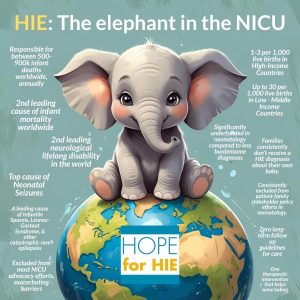
HIE is the second leading cause of neonatal mortality worldwide, surpassed only by prematurity complications1.
An estimated 900,000 newborns die each year from intrapartum-related events, most of which involve HIE, disproportionately affecting low- and middle-income countries (LMICs)2.
HIE is the #1 cause of neonatal seizures, accounting for up to 80% of seizures in term newborns3. Babies with neonatal seizures are at greater risk for developing epilepsy, and HIE is a leading cause of catastrophic rare epilepsies like Infantile Spasms, Lennox-Gastaut Syndrome, and others.
Among survivors of moderate to severe HIE, 40–60% experience long-term neurodevelopmental disabilities such as cerebral palsy, epilepsy, and cognitive or behavioral impairments4.
The global incidence varies dramatically: ~1.5-3 per 1,000 live births in high-income countries and 10–30 per 1,000 in LMICs, with wide disparities in diagnosis and access to treatment5.
The Mismatch: High Impact, Low Investment
Despite this burden, HIE remains alarmingly underrepresented in:
Public health policy: Major global child health initiatives often exclude HIE as a standalone priority, lumping it into broader perinatal categories without actionable focus.
Research funding: HIE receives a fraction of neonatal neuroscience funding, especially outside of high-income countries6.
Therapeutic development: The one approved therapeutic intervention, therapeutic hypothermia, is resource-dependent, leaving LMICs without proven, scalable interventions7.
Lifespan care: Long-term outcomes are poorly tracked, especially for those with mild HIE leaving families to navigate fragmented systems with little guidance.
The result? A condition with massive global impact but minimal strategic response.
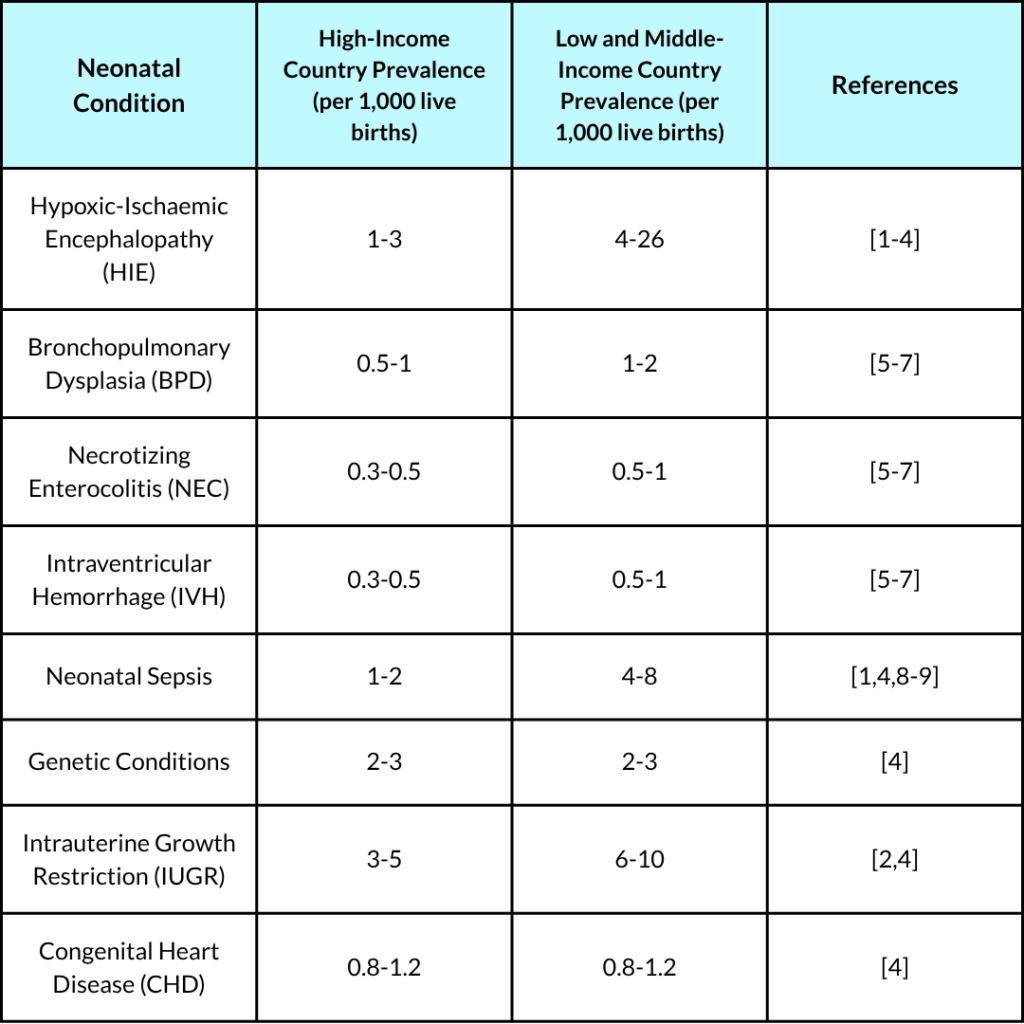
Neonatal Conditions & Prevalence
What is the prevalence of HIE compared to other prioritized global neonatal conditions? Let's take a look!
Note: Conditions listed reflect those commonly cited in neonatal burden of disease analyses and clinical prioritization frameworks. Data derived from published systematic reviews, burden of disease studies, and international cohort analyses.¹-⁹
What Hope for HIE Is Doing: Leading the Charge
As the global leader in HIE advocacy, Hope for HIE is actively working to change this reality by building a coordinated, collaborative ecosystem focused on patient-centered progress across the care continuum.
Our Initiatives Include:
Global Research Collaboration: Partnering with top academic institutions and clinical trial networks to embed family voices in research design, ethics, and dissemination. We are building a HIE registry meant to bridge global barriers, and drive meaningful patient-family-centered research.
Lifespan Advocacy: Elevating the long-term needs of HIE survivors and caregivers through strategic policy advocacy, lifespan-focused clinical education, and community-driven resource development.
International Task Forces: Convening interdisciplinary working groups to address urgent gaps in clinical care, therapeutic advancement, long-term follow up, and prevention.
Clinical Trials Innovation: Launching the award-winning Halo of Support™ framework to enhance equitable recruitment and retention in neonatal HIE research, particularly among historically excluded populations.
Medical Advisory Leadership: Collaborating with expert neonatologists, neurologists, therapists, and families to guide evidence-based recommendations and co-design resources that meet real-world needs.
Global Equity Focus: Advocating for contextualized care pathways in LMICs, including scalable education, clinical guidance, and peer-to-peer family support in under-resourced settings.
We’re not just raising awareness — we’re building the systems that families need and the accountability research demands. And we need your help to do it!
🧠 A Call to Action: Match the Response to the Reality
We must stop treating HIE as a clinical footnote. It's time to realign the global health response to reflect the reality families face.
Here's what needs to change:
Prioritize HIE in global maternal and child health policy making
Fund equity-driven research that reflects patient-family-centered, co-produced priorities for the global incidence and resourcing needs
Ensure families and survivors are represented in all stages of research and care planning
Invest in post-discharge systems of care that address lifelong outcomes, not just NICU survival
The Bottom Line
HIE needs global resourcing for prevention, intervention, improved clinical care, safe and effective therapeutics, and policy to support this population and the long-term impacts of this burden.
References
Ou Z, Yu D, Liang Y, et al. Global trends in incidence and death of neonatal disorders and its specific causes in 204 countries/territories during 1990–2019. BMC Public Health. 2022;22(1):360. https://doi.org/10.1186/s12889-022-12765-1
Kurinczuk JJ, White-Koning M, Badawi N. Epidemiology of neonatal encephalopathy and hypoxic–ischaemic encephalopathy. Early Hum Dev. 2010;86(6):329–338. https://doi.org/10.1016/j.earlhumdev.2010.05.010
Acun C, Karnati S, Padiyar S, et al. Trends of neonatal hypoxic–ischaemic encephalopathy prevalence and associated risk factors in the United States, 2010 to 2018. Am J Obstet Gynecol. 2022;227(5):751.e1–751.e10. https://doi.org/10.1016/j.ajog.2022.06.002
Blencowe H, Vos T, Lee AC, et al. Estimates of neonatal morbidities and disabilities at regional and global levels for 2010: introduction, methods overview, and relevant findings from the Global Burden of Disease Study. Pediatr Res. 2013;74(Suppl 1):4–16. https://doi.org/10.1038/pr.2013.203
Ramaswamy VV, Abiramalatha T, Bandyopadhyay T, et al. ELBW and ELGAN outcomes in developing nations: systematic review and meta-analysis. PLoS One. 2021;16(8):e0255352. https://doi.org/10.1371/journal.pone.0255352
Lui K, Lee SK, Kusuda S, et al. Trends in outcomes for neonates born very preterm and very low birth weight in 11 high-income countries. J Pediatr. 2019;215:32–40.e14. https://doi.org/10.1016/j.jpeds.2019.08.020
Shah PS, Lui K, Sjörs G, et al. Neonatal outcomes of very low birth weight and very preterm neonates: an international comparison. J Pediatr. 2016;177:144–152.e6. https://doi.org/10.1016/j.jpeds.2016.04.083
Xin J, Luo Y, Xiang W, et al. Measurement of the burdens of neonatal disorders in 204 countries, 1990–2019: a Global Burden of Disease-based study. Front Public Health. 2023;11:1282451. https://doi.org/10.3389/fpubh.2023.1282451
Peng R, Tong Y, Yang M, et al. Global burden and inequality of maternal and neonatal disorders: based on data from the 2019 Global Burden of Disease Study. QJM. 2024;117(1):24–37. https://doi.org/10.1093/qjmed/hcad220