

Children grow and change tremendously from infancy through adolescence. The skills we use to understand their development need to grow with them, too.
For children with a history of HIE, developmental follow-up gives families and care teams opportunities to understand strengths, recognize areas where support may be helpful, and respond to a child's changing needs over time.
In the early years, that may mean watching motor development, communication, feeding and early learning. At school age, the picture expands to include attention, memory, learning, executive functioning, behavior, friendships and participation at school and in the community.
Long-term follow-up isn't about expecting something to go wrong. It's about making sure children have access to the right support at the right time — and recognizing how much development continues to unfold throughout childhood.
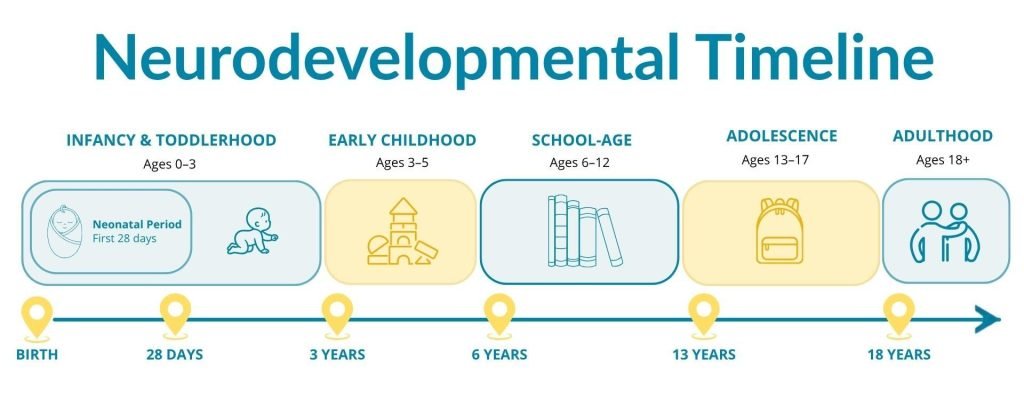
Early developmental assessments provide valuable information.
During infancy and toddlerhood, clinicians can evaluate areas such as:
These assessments can identify opportunities for Early Intervention, therapy or other support during a period of rapid brain development.
But neurodevelopment doesn't stop at age two.
As children grow, entirely new abilities emerge — and those abilities give us new information about how their brains learn, adapt and function.
A toddler isn't yet being asked to read a chapter, organize a backpack, remember a series of instructions, complete a math problem, manage a busy classroom or navigate increasingly complex friendships.
By school age, children are developing and using skills involving:
These aren't simply additional things to “watch for", they are new stages of neurodevelopment.
Following children over time allows us to understand these parts of development when they actually become measurable.
Development continues well beyond elementary school.
Executive functioning, emotional regulation, independence, social cognition and other higher-order abilities continue developing through adolescence.
That reflects an important evolution in HIE care and research.
Instead of asking only:
“Did this child survive without major disability?”
we can ask:
“How is this child developing, learning, participating and thriving — and what will help them continue to do so?”
Long-term studies have taught us a tremendous amount about HIE. They have also shown us how much we still need to learn.
Much of the foundational HIE outcomes research was designed around specific clinical trials, particular HIE severity groups and developmental endpoints at 18–24 months. School-age studies have added critically important information, but they are fewer, often involve smaller groups of children, and don't always measure the same outcomes in the same ways.
And then there is one of the questions families ask us most often:
“What happens when they get older?”
For many families, that doesn't mean age five or even age ten. They want to know what HIE may look like in adolescence and adulthood.
What happens to mobility over time? How do epilepsy and other neurological conditions evolve? What does learning and cognitive functioning look like in adulthood? What kinds of support might someone need for education, employment or independent living? How do mental health, relationships, communication, participation and quality of life change? What does healthy aging look like for someone who experienced a brain injury at birth?
For individuals with more significant disabilities and medical complexity, families may also be thinking about future caregiving needs, adult healthcare, community supports and what life will look like when parents can no longer provide the same level of care.
We simply don't have enough longitudinal HIE-specific data to answer many of these questions well....YET.
We need research that follows the full spectrum of HIE across the lifespan.
We need to understand cognition, learning, communication, behavior, epilepsy, vision, motor function, mental health, participation and quality of life over time. We need to know which early clinical factors are actually useful for understanding later development. And we need to understand which interventions and supports make the greatest difference for children, adults and families.
We also need to measure outcomes that matter to people living with HIE and their families — not only the outcomes that have traditionally been easiest to measure in clinical trials.
These are some of the gaps Hope for HIE is working to address through the HIE Registry.
The HIE Registry is being developed to bring together standardized clinical information with information reported directly by families, creating a more complete longitudinal picture of HIE.
As the Registry grows, the goal is not simply to collect more data. It is to build the kind of long-term, real-world evidence that has been missing: evidence that can help us understand how people with HIE develop across childhood, transition into adulthood, and experience health and life over time.
That can help researchers identify patterns and unanswered questions, improve clinical counseling and follow-up, design better studies, and focus future research on outcomes that are meaningful to people living with HIE.
Just as importantly, families and people with HIE become active contributors to what we know.
Ultimately, we want to be able to answer “What happens when they get older?” with far more information than families have today.
Every person's developmental path adds to our understanding of what HIE can look like — not just at age two, but across a lifetime.
No single age tells us everything about a child's development.
Infancy gives us one picture.
Toddlerhood gives us another.
School age and adolescence add new information as children's abilities, environments and opportunities expand.
For children with HIE, thoughtful long-term follow-up allows care to grow alongside the child — recognizing strengths, identifying support when it is useful, and helping every child participate as fully as possible in family, school and community life.
Explore our HIE Outcomes resource to learn more about the spectrum of HIE outcomes and what research tells us about development across childhood.
Connect with families, read inspiring stories, and get helpful resources delivered right to your inbox.


Connect with families, read inspiring stories, and get helpful resources delivered right to your inbox.


